
This is an informative and educative blog whose main objective is promoting knowledge of different disciplines .If you find this useful, please share it with your friends.
Antimatter
Antimatter ,as the name suggests, is matter which is composed of particles that have opposite charge to ordinary matter.It is now believed that all particles have their antimatter particle counterparts .Positrons are the antiparticles of electrons and anti protons are the opposite of protons while neutrinos might be their own antiparticles. Although in theory all elements of matter should have their antimatter counterparts, elements that are more complex than anti helium have not yet been discovered or created.Antimatter should not be confused with dark matter which hypothetically accounts for most of matter in the universe.
When matter and antimatter collide , they annihilate each other producing intensive radiation of photons and energy.Therefore, one of the unsolved mysteries in physics is why an ultimate annihilation of this kind did not happen at the beginning of the universe when matter and antimatter are supposed to have been equal in abundance.Another issue in science is why antimatter is not so common in the universe as it is supposed to be , i.e, why matter and antimatter are asymmetric in their existence in the universe.Some scientists think the answer lies far in the cosmos where entire galaxies of antimatter might exist.
When matter and antimatter collide , they annihilate each other producing intensive radiation of photons and energy.Therefore, one of the unsolved mysteries in physics is why an ultimate annihilation of this kind did not happen at the beginning of the universe when matter and antimatter are supposed to have been equal in abundance.Another issue in science is why antimatter is not so common in the universe as it is supposed to be , i.e, why matter and antimatter are asymmetric in their existence in the universe.Some scientists think the answer lies far in the cosmos where entire galaxies of antimatter might exist.
The Multiverse
Although the idea of a multiverse might sound rather philosophical and more akin to science fiction than to serious science,and despite the fact that no empirical evidence supporting it has been fully established yet; it is not implausible under the implications of many modern scientific theories.
Many people assume that since we have not yet found any limits to our observable universe and since we have always been able to discover new countless solar systems and galaxies beyond ours,there is nothing to exclude the existence of other universes beyond ours as well. However,if we define the universe as every thing that exists,there will be just an extension of the same universe instead of multiple universes. According to many theorists, in order to have different universes , we need to have systems acting under different physical laws and with different dimensions as well.
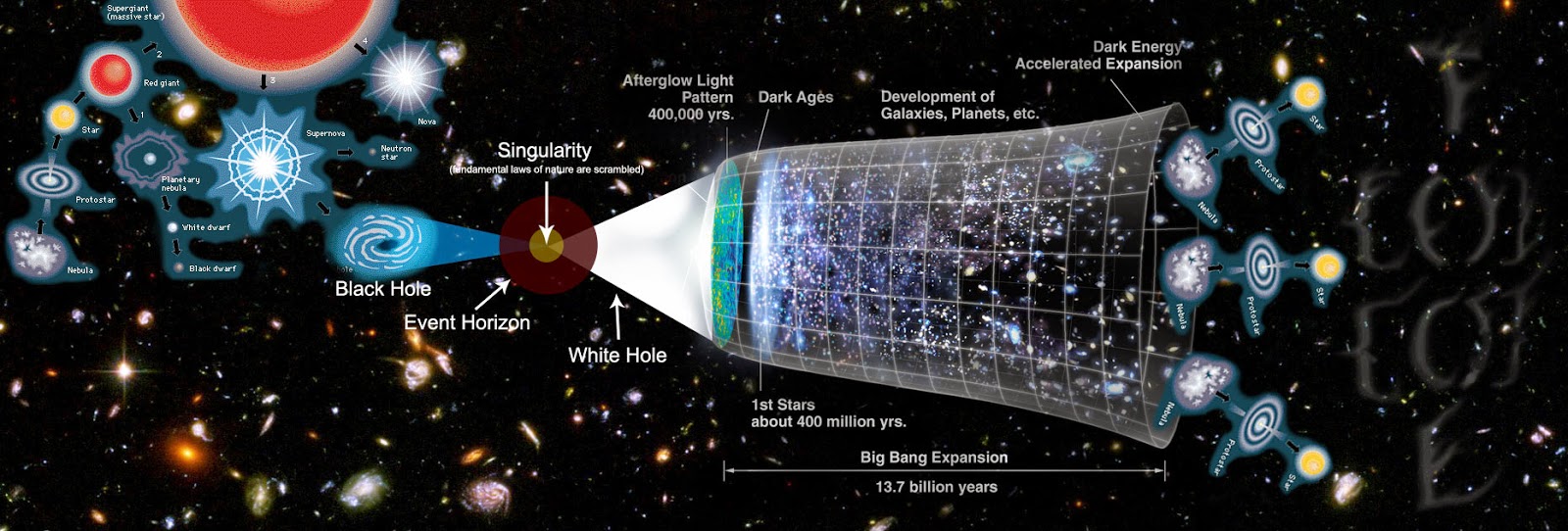
One of the versions of multiverse hyptheses, lies within the inflation theorywhich is the version of the big bang stating that a brief exponential expansionoccurred in the very early moments of the universe causing isolated pocket universes of which our universe is a specimen.Quantum mechanics also offers another hypothesis known as parallel universes by bringing possibility to actuality ,i.e, different porobablities give rise to diffetent occurrences in differentspace–time dimensions.In additin to the previous hypotheses , some propose that there might be other universes beyond black holes: when a black hole absorbs matter,and energy, they are consequently released from the other side(what some theorize as a white hole)and by simple inference, we might also be living inside a large black hole.But without adequate experimental evidence,these hyptheses will be just mere speculations and many intellectuals think they are untestable at all.
Many people assume that since we have not yet found any limits to our observable universe and since we have always been able to discover new countless solar systems and galaxies beyond ours,there is nothing to exclude the existence of other universes beyond ours as well. However,if we define the universe as every thing that exists,there will be just an extension of the same universe instead of multiple universes. According to many theorists, in order to have different universes , we need to have systems acting under different physical laws and with different dimensions as well.
One of the versions of multiverse hyptheses, lies within the inflation theorywhich is the version of the big bang stating that a brief exponential expansionoccurred in the very early moments of the universe causing isolated pocket universes of which our universe is a specimen.Quantum mechanics also offers another hypothesis known as parallel universes by bringing possibility to actuality ,i.e, different porobablities give rise to diffetent occurrences in differentspace–time dimensions.In additin to the previous hypotheses , some propose that there might be other universes beyond black holes: when a black hole absorbs matter,and energy, they are consequently released from the other side(what some theorize as a white hole)and by simple inference, we might also be living inside a large black hole.But without adequate experimental evidence,these hyptheses will be just mere speculations and many intellectuals think they are untestable at all.
A Theory of Every Thing
Since the development of The theories of relativity and quantum mechanics, many attempts have been carried out by Physicists to combine them into one unified theory which would be referred to as a master theory or a theory of every thing.Scientific experiments have shown and proved the validity of both theories in their respective areas of study.General relativity has passed many tests and made may successful predictions in the macroscopic scale.Moreover, it has become the basis and the starting point for many cosmological and astrophysical theories and concepts.On the other hand, quantum mechanics has been the cornerstone of our understanding of all the issues in the microscopic scale of the universe.
General Relativity covers the force of gravity which is the only of four interactions not tackled by quantum mechanics,while quantum physics studies electromagnetism ,the strong nuclear force and the weak nuclear force.It has been a long and arduous quest for physicists to unify all the four forces in a general unified theory. Although many field theories have been developed and were able to successfully unify some of the three quantum forces ,incorporating gravity into these theories has always been an elusive task.A theory of every thing is necessary for a deeper understanding of singularities where the current laws of physics break down such as the center of black holes or the early moments of the Big Bang.Many theories have been proposed like the string theory which has a solid mathematical support.However,they still need testablity through experimentation what would make them valid and accepted scientific theories.
General Relativity covers the force of gravity which is the only of four interactions not tackled by quantum mechanics,while quantum physics studies electromagnetism ,the strong nuclear force and the weak nuclear force.It has been a long and arduous quest for physicists to unify all the four forces in a general unified theory. Although many field theories have been developed and were able to successfully unify some of the three quantum forces ,incorporating gravity into these theories has always been an elusive task.A theory of every thing is necessary for a deeper understanding of singularities where the current laws of physics break down such as the center of black holes or the early moments of the Big Bang.Many theories have been proposed like the string theory which has a solid mathematical support.However,they still need testablity through experimentation what would make them valid and accepted scientific theories.
Quantum Mechanics
Quantum mechanics consitutes the branch of physics which studies pyhsical phenomena and physical interactions at the microscopic scale.This branch of physics stems from the atomic theory which goes back to ancient times when the concept of the atom was first proposed.Quantum mechanics encompasses a wide range of concepts and principles which govern and mathematically describe the motions and interactions of subatomic particles of matter and energy.The principal concepts of quantum mechanics include: quantization of energy, wave-particle duality and uncertainty principle.
In 1900, Theoretical Physicist Max Planck demonstrated that radiations of heated objects were emitted in discrete units of energy which he called quanta(plural of quantum).Planck also showed the relationship between the size of the energy and the frequency of radiations by introducing the Planck Constant. later in 1905 Albert Einstein proposed that light is made up of discrete packets of energy which he called photons and thus altered the classical concept of continuous emission.Einstein went further to show that light exhibited properties of waves as well as those of particles , a concept known as wave-particle duality.The new concept concluded a very long debate among physicists over the nature of light,but later it was shown that even electrons ,and hence all matter had wave -like properties.In 1927, a major breakthrough was made in quantum studies with the introduction of The uncertainty principle by Werner Heisenberg which states that determining both the position and the momentum(speed) of a particle simultaneously is impossible, as the more precisely either of these two elements is calculated the less precisely the other element ‘s value becomes. This principle introduced probability as an alternative to certainty in the subatomic field.
Quantum mechanics covers an area which includes three of the four fundemental interactions which are: electromagnetism, the strong nuclear force and the weak interaction.Therefore, many unsuccessful attemts have been made by scientists to build a unified theory which would include all the four interactions and thus fully explain and understand all the aspects of the phsical universe .
In 1900, Theoretical Physicist Max Planck demonstrated that radiations of heated objects were emitted in discrete units of energy which he called quanta(plural of quantum).Planck also showed the relationship between the size of the energy and the frequency of radiations by introducing the Planck Constant. later in 1905 Albert Einstein proposed that light is made up of discrete packets of energy which he called photons and thus altered the classical concept of continuous emission.Einstein went further to show that light exhibited properties of waves as well as those of particles , a concept known as wave-particle duality.The new concept concluded a very long debate among physicists over the nature of light,but later it was shown that even electrons ,and hence all matter had wave -like properties.In 1927, a major breakthrough was made in quantum studies with the introduction of The uncertainty principle by Werner Heisenberg which states that determining both the position and the momentum(speed) of a particle simultaneously is impossible, as the more precisely either of these two elements is calculated the less precisely the other element ‘s value becomes. This principle introduced probability as an alternative to certainty in the subatomic field.
Quantum mechanics covers an area which includes three of the four fundemental interactions which are: electromagnetism, the strong nuclear force and the weak interaction.Therefore, many unsuccessful attemts have been made by scientists to build a unified theory which would include all the four interactions and thus fully explain and understand all the aspects of the phsical universe .

General Relativity
In 1915, Albert Einstein extended his theory of relativity to include accelerated motion and gravitational fields . Newton formed the universal law ofuniversal gravitation in which he described gravity as a force which obtains between any two non-zero mass objects that is directly proportional to to their masses and inversely proportional to square of the distance between them.
Einstein redefined gravity as a curvature or distortion of the space–time continuum which is caused by the matter contained in it, i.e,it is an interaction between spacetime and matter.Under the theory of relativity, gravity became amanifestation of the spacetime cutvature which is due to the presence of mass. In its extended form, relativity predicted the deflection and red shifting of lightwhen it passes through a gravitational field. These predictions were confirmed by many observations and experiments. Einstein also noted that gravity does not work instantaneously as Newton proposed,but it acts exactly at the speed of light. Many theories and concepts in astrophysics like ; The Big Bang,black holes and gravitational waves are based on general relativity what makes it a cornerstone in our astronomical and cosmological studies.
Einstein redefined gravity as a curvature or distortion of the space–time continuum which is caused by the matter contained in it, i.e,it is an interaction between spacetime and matter.Under the theory of relativity, gravity became amanifestation of the spacetime cutvature which is due to the presence of mass. In its extended form, relativity predicted the deflection and red shifting of lightwhen it passes through a gravitational field. These predictions were confirmed by many observations and experiments. Einstein also noted that gravity does not work instantaneously as Newton proposed,but it acts exactly at the speed of light. Many theories and concepts in astrophysics like ; The Big Bang,black holes and gravitational waves are based on general relativity what makes it a cornerstone in our astronomical and cosmological studies.


Originally posted here: http://peeweewiki.blogspot.com/
